
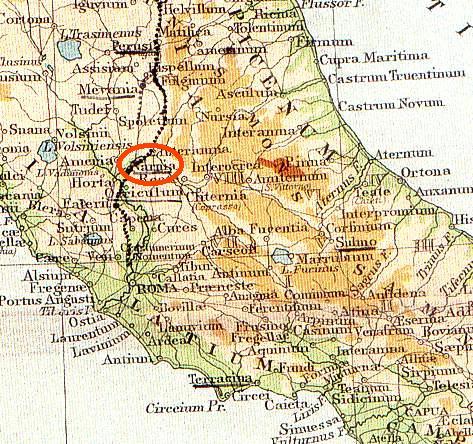
jgoble wrote:In one of Pliny the Younger's letters in Book I, he refers to a villa owned by his mother-in-law as a very pleasant place. The villa is called Narnia.
Did C.S. Lewis ever say or write anything indicating that he got the name Narnia from Pliny's works? Because of his strong interest in the classics, this seems at least plausible.
Jim Goble
My wife Angelee was reading to our son Gawain (whom we homeschool) some classic texts and one of them was a letter to Gallus from Pliny the Younger. She hadn't read it before and when she did, she was so intrigued that she called me at work to read it to me over the phone. It was fascinating and peculiarly relevant to these forums perhaps. See what you think. Here it is:
---------------------------------------
…My wife's grandfather asked me to look around his estate near Ameria. As I was walking over his grounds I was shown a lake that lies below them, called Vadimon, and given at the same time an incredible account of it. So I went close up to this lake. It is exactly circular; there is not the least break or bend in the circle, but all is regular and just as if it had been hollowed and cut out by the hand of art. The colour of its water is a whitish-blue, verging upon green, and somewhat cloudy; that has the odour of sulphur and a strong medicinal taste, and possesses the property of cementing fractures. Though it is but of moderate extent, yet the winds have a great effect on it, throwing it into violent commotion.
No vessels are permitted to sail here, as its waters are held sacred; but several grassy islands swim about it, covered with reeds and rushes, and whatever other plants the more prolific neighboring marsh and the borders of the lake produce. No two islands are alike in size or shape; but the edges of all of them are worn away by their frequent collision against the shore and one another.
They have all the same depth, and the same buoyancy; for the shallow bases are formed like the hull of a boat. This formation is distinctly visible from every point of view; the hull lies half above and half below the water. Sometimes the islands cluster together and seem to form one entire little continent; Sometimes they are dispersed by veering winds; at times, when it is calm, they desert their station and float up and down separately.
You may frequently see one of the larger islands sailing along with a lesser joined to it, like a ship with its long boat; or perhaps, seeming to strive which shall outswim the other; then again all are driven to one spot of the shore of which they thus form a prolongation. In one place or another they are constantly diminishing or restoring the area of the lake, only ceasing to contract it anywhere, when they occupy the center. Cattle have often been known, while grazing, to advance upon those islands as upon the border of the lake, without perceiving that they are on moving ground, till, being carried away from shore, they are alarmed by finding themselves surrounded by water, as if they had been put on board ship; and when they presently land wherever the wind drives them ashore, they are no more conscious of disembarking than they had been of embarking. This lake empties itself into a river, which after running a little way above ground sinks into a cavern and pursues a subterraneous course, and if anything is thrown in brings it up again where the stream emerges.
----------------------
I'm posting this here because of the Pliny thread connection, but I suppose it properly belongs in either the Perelandra Study or Space Trilogy forum too. I may post a copy of it in one of those places (or perhaps, does it qualify as a "keeper" instead, DZ?)
--Stanley
…on a night of rain Frodo smelled a sweet fragrance on the air and heard the sound of singing that came over the water. And then it seemed to him that as in his dream in the house of Bombadil, the grey rain-curtain turned all to silver glass and was rolled back, and he beheld white shores and beyond them a fair green country under a swift sunrise.